

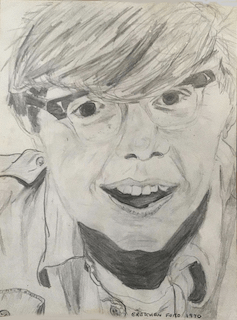
Had he lived beyond his 18 years, our oldest son Mark would have been 69 years old this year. You might figure that’s enough time gone by that we should be letting him rest in peace, but thanks to the tenacity of the Ford Horde, we’re never going to really let him leave us.
Some days are good days and some days are bad. And some days are both. For my husband Gene and me, December 19th, 1970 was that kind of day. It was Gene’s birthday, but it was also to become the worst day of our lives.
Gene was still at work. I was busy cooking his birthday supper and two of the girls were setting the table when the phone rang. I picked it up to hear the news all parents fiercely dread: our 18 year-old son Mark – running across the street to his Sea Scout Skipper’s house – had just been hit by a car and was unconscious. He died two days later.
I don’t need to describe the grief to you. Today – 50 years later – the memory of the pain of it still takes my breath away. God giveth and He taketh away. But in our case, He had also given us our merciful means of survival – six other children. What must it be like to lose an only child? How do the parents ever survive it? It’s incomprehensible.
Mark himself gave us one other survival tool: from 7th or 8th grade in school, he began writing a collection of poetry that has lived on and sustained us all these years. Many of us are still able to quote lines of it from memory, and it seems like it keeps improving with age. An example of its timelessness is the last sonnet he wrote. He had just finished it two days before the accident that took his life. Last year, my daughter Teresa produced a video rendition of it that appears at the end of today’s blog.
But the real reason I’m writing this today is because I’m flat-out amazed and excited that a collection of Mark’s poems and a memoir that daughter Judy Taylor wrote about him is being published and, in a few weeks, will be available on amazon.com, and, we hope, in libraries. It’s called “The Boy Who Wrote Poetry”. Judy has already produced several award-winning books on Nantucket rug hooking, but this is her first venture into a subject like this one. If you’d like a glimpse, the following is the Foreword of the book.


My brother, Mark Peter Ford, was a poet.
Mark’s influence in my life has been profound, thanks to a little gray book of poetry which has captivated me for five decades. I marvel at the skillfulness of his writing, particularly considering his age when he wrote. But I am even more impressed with the perceptiveness in his poems, displaying wisdom far beyond his age. Indeed, as I approach my sixtieth year, I still struggle with issues such as “What is love?” “Why are we here?” and the depths of grief, forgiveness and loss. Mark not only asked these perennial questions, but he achieved great clarity in his answers.
Mark was the oldest of seven children born to Patricia and Gene Ford. I am the youngest of that Ford brood. By the time I came along (1961), the Ford family occupied an 1800 square-foot, two-story shoebox on Capitol Hill in Seattle, Washington. It’s fair to say I played only a bit part in the story of Mark’s life, since I wasn’t alive for the first half, and in the second half, I confess I was more interested in Barbie dolls and roller skates than the wonders of iambic pentameter. My role in the story took place many years after my brother died.
There were four “bedrooms” in the Capital Hill house, although if you were to look at them today, you might think them walk-in closets with doors. The remodeled attic had “cubby holes” which served as bedrooms for the younger children. There was one bathroom. Yes, you got that right. Seven grubby (and two relatively clean) humans–one bathroom.
Everywhere the Ford family went, it was a production. Mom used to count seven heads as we left the house, then when we set off for home, she would count seven heads again (then there was the time when I got left behind at Baskin & Robbins, but the scars of that emotional tragedy will have to wait for another book). By the standards of our Catholic neighborhood, our family was actually considered small. Ten to fourteen children per family was the norm.

There were at least 100 school-age children just on our block, and the Ford kids played every day until dusk along 20th Avenue East and Aloha Street. We played kick the can, capture the flag, red rover, baseball, kickball, water fights and snowball fights. Several times a year we would decorate our bicycles and wagons, dress up in costumes and “parade” down the street, for the amusement of our parents. Most of the kids went to St. Joseph’s until the eighth grade; then the girls went to Holy Names Academy and the boys went to Seattle Prep.
It was the 1960’s and Mark was growing up. Although we shared this large, bustling family and neighborhood, Mark and I didn’t really get to know each other. I was the baby of the family, and he was on the verge of manhood. My older siblings seemed like giants to me then. Way too cool for kids. I have fond memories of my oldest brother, but we never got to develop that closeness I now have with my other brother and sisters today. How could we have known that we would not get the chance?
Mark died when he was only eighteen. At age nine, I was old enough to understand that death meant the person would never come back, but I could scarcely comprehend the grief my family suffered, especially my parents. I could perceive only that a great tragedy had befallen our family.
Ordinarily, when a sibling dies, you would expect the memories to fade over time. The images in your mind tend to soften around the edges, like black and white photographs, tattered and wrinkled. At that point, it would surely have been the end of Mark’s story for me, except that, when Mark died, my parents, amidst what must have been unimaginable grief, did an extraordinary thing. They published a book of Mark’s poems, as a tribute to his life.
7
One can only imagine what it must have been like for my parents to lose their oldest child, just at the time he was on the verge of adulthood. They could have gotten angry at God for snuffing out this precious life too soon. They could have rejected God’s plan and questioned their own faith, but they didn’t. My parents are people of tremendous energy, creativity, courage and faith. Rather than dwelling on the tragedy of Mark’s death, they chose to affirm and celebrate his life.

They chose eighteen of his poems for the book, one for each year of his life. This little book was printed on heavy, textured paper with a simple gray cover. My parents asked my sister Gretchen (then age 13) to add her own sketches to the poetry. Gretchen’s drawings are simple and spare, adding to the images in Mark’s words.
My parents gave the little book away at Mark’s funeral (excerpt on the following page), and we have continued to share the book with close friends and family ever since. I was too young to understand Mark’s poems at the time, but I continued to read them as I grew up. I found that they changed for me as I matured. As I got older, I was able to discover new layers of meaning and depth in his words. In times of joy and in moments
of despair, Mark’s words would echo in my head.
2020 will be the 50th anniversary of Mark’s death. After enjoying these treasured poems for so many years, I am moved to ask questions about who this extraordinary young man was. What were the influences in his life that made him express himself with poetry? How did he develop his talent and skill? With the help of my family and Mark’s friends, I hope to find out.

This concludes the Foreword of Judy’s book, and I hope it makes you look “forward” to the rest of it, too.
In the meantime, here’s our talented Teresa’s video interpretation of Mark’s last sonnet. Mark was so excited about it that he had brought it to me at work to read the day before the accident. The driver of the car found it in Mark’s pocket when he was searching for his ID and was deeply affected and consoled by it.


I loved Mark. He was a friend like a brother, and I still think of him often, and miss him. I will look for this new book coming out. Thank you for it! It is a gift!
Is this really you, Susie? Daughter of Mary and Boyd? Big sister to Stevie and Bobby and Howie Ka-Powie? I love the internet!
No words!
No words. Only tears for this lovely post by mom, Judy and Teresa. Love the writing by mom, Judy and Mark. Love the artwork by Gretchen. Love the video by Teresa. Can’t wait to get the new book. Thank you everyone!