


The months of December and January are marked with grim and painful anniversaries in the Ford and Gorman families. Today, for instance, is the anniversary of the death of my husband Gene’s grandfather, Henry Patrick Ford. Henry’s is a sad and terrible story but I’m going to recount it here for the benefit of his 17 living great-grandchildren, and his 26 great-great grandchildren, many of whom are readers of this blog.
The story is pieced together from the genealogy and documentation my brother-in-law Robert Ford unearthed, and from photos and news clippings that had been saved by my mother-in-law Mabel O’Hanlon Ford.
Henry Patrick Ford was born in Bath, Maine in 1858 of first generation Irish immigrants to the United States. We don’t know when or why he moved to the Midwest, but Bath, Maine was a shipbuilding town, and the work of building the wooden sailing ships may have dried up after the Civil War. Henry’s family probably headed west in search of gainful employment.


Shortly before the marriage, Henry was hired as a switchman for the Chicago, Rock Island & Pacific Railroad there. He earned $45 per month.

A switchman worked in the yard under the direction of a yardmaster. They built trains by switching out tracks full of cars, coupling and uncoupling them with a coupler like that pictured here.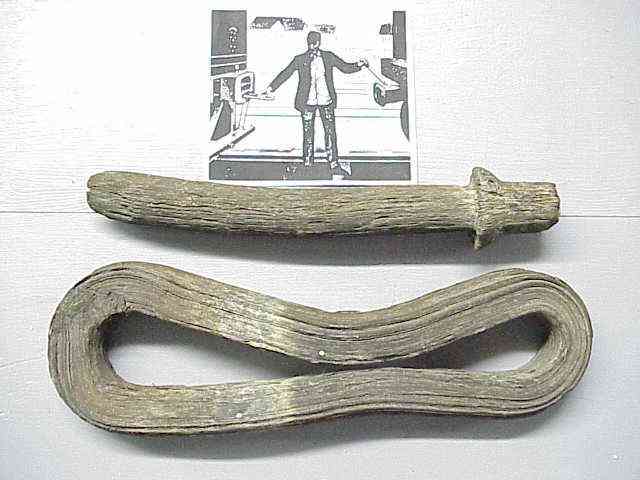
At the east end of the West Liberty train yard was a dangerous, poorly maintained cattle guard that the switchmen had to step over while working on the train cars 3 to 10 times per day.

The cattle guard was a subject of worry and complaint among the men. In fact, as soon as Henry was hired, he went to the yardmaster to complain. He referred to it as a “man-trap” and demanded that it be fixed.
The yardmaster assured him that it would be repaired at once. It wasn’t. On Wednesday, or Thursday, December 11, 1890, Henry went to the yardmaster again, this time with two of the other men, and he demanded to know why the cattle guard hadn’t been fixed. The yardmaster equivocated, and finally Henry announced that if it wasn’t fixed immediately, he would “quit right then and go back on the road” and he made it clear that he wouldn’t continue to work over such a dangerous trap.
On Saturday, though, Henry was still working in the yard. He probably couldn’t follow through on his empty threat because his bride of seven weeks had become pregnant. He may have feared not being able to pay the rent more than he feared the job’s danger.
That Saturday, December 13, 1890, Henry was attempting to make a coupling on a train that was being set up, and several cars were switched onto a side track. The train was backing down to some cars that were to be coupled on, and just then Henry stepped into the cattle guard and became trapped. Before he could extricate himself, the train backed down upon him killing him instantly, and four more cars ran over him mangling his body horribly.
In the florid journalese of the day, the West Liberty newspaper wrote that “he was caught by the moving train in such a manner as to completely disembowel him and crush almost every bone in his body. The remains presented a ghastly sight. After restoring the body to as nearly its original shape as possible, it was carried home to the family residence . . . “


During those years, she was somehow raising her son – Patrick. Patrick was my father-in-law. Sixteen years after Henry’s death, Mary married again, this time to a widower and farmer named James Patrick Downs from Emmetsburg, Iowa. They lived together there till her death in 1943.

After I heard Henry’s story, I really marveled at the kind of father his son became. My father-in-law Pat – raised as a fatherless child with no role model to observe and learn from – was a textbook example of how to be a “good father” to one’s children. Go figure. Henry may have been tragically absent for Pat’s upbringing but his genes and good character were definitely present and accounted for. As a role model, he managed to be “All Aboard” after all, and his family has good reason to be proud of him and to remember him.
(Does anyone besides me think that Henry looks like my nephew Eddie Ford and that Mary looks like my niece Leslie Ford Sully?)


