


I signed up for an Evelyn Woods Speed Reading Course in the 1970s. At the time, my working life involved lots of slogging through formidable technical instruction. I was hoping to improve my speed and comprehension of gobbledegook.
I wish I could say I achieved my objective. I didn’t, but I did come away from it with two useful impressions:
- 1. Anyone who believes it is possible to “speed read” technical manuals – like how to write Unix computer code, for instance – is a deranged nutcase.
- 2. The second impression was made the very first night of the class. The instructor asked each of us to describe what we hoped to get out of the course. One of the attendees was a young man (who for some inexplicable reason was wearing a Civil War uniform). When it was his turn to say why he was there, he explained it this way: “I have an addiction to reading and it’s a habit I couldn’t otherwise afford to feed – without this”. Raising his hand, we saw that he was holding his public library card. “Besides time, this is all I need”, he said.

When I cleaned out my purse last week, I was handling my Seattle public library card and got to thinking about that incident, and about the effects that dog-eared card has had on my life. Not just because of my reading enjoyment or education, or entertainment but because of how much money it saves me every year.

Public libraries in America are dedicated to a crazy common purpose: they want us to take advantage of them. When they find out you want to find and apply for a job, or there’s something you want or need help with, or need to know, or a skill or activity or language you want to learn, they will walk through fire to see that you can achieve it. All for FREE. As long as you have a library card, ALL YOU NEED TO DO IS ASK!

First, naturally, we have to talk about BOOKS! I haven’t stepped foot in a library’s physical location for a few years, but I’m online, constantly downloading to my Kindle up to 25 books at one time and it’s easy as pie. I can have 25 reserved and the system lets me know when each is available. I’ve read 640 books since 2016, and the reason I know that is because I use the option of letting the library save my “history”. It’s a list I can sort (and print if desired) in the order of title, author, or the date I checked it out. If I forget what one of the books was about, I can still check out the book’s “details”. If I don’t like one I start, I just return it and turn off the history flag.
In my last post, I mentioned how the library helped me get a job. Today, you can always reserve time at a computer with internet access. You can use copiers at the library too, but you’ll have to pay a little for each copy you make.The job, employment and career opportunity resources for job seekers today – including computer use and internet access – are one of the library’s most vital contributions to our community.
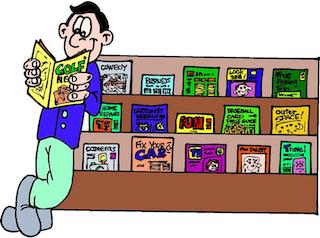
My husband and I subscribed to magazines for years, but today I can read them for free online, on the “Newspapers and Magazine database. Time, Cook’s Illustrated, Vogue, Better Homes and Gardens, The New Yorker, and oodles more. Not just current issues but archived ones, too. They’re just as interesting and inviting on an iPad as they are in print.

As for newspapers! As one of the last hardcore antiquarians, I still subscribe to actual printed copies of our daily newspaper, the Seattle Times. Including the paper copies delivered to the house and my digital subscription, I’m spending $696 per year for it. I’m still doing that because I’m afraid the minute I stop, they’ll go bankrupt (plus I won’t have anything to wrap the yard waste in!) This is in spite of the fact that I could read it for free on the library’s online database every morning. (I do sometimes use the database though for combing back through years of archives searching for an article, or somebody’s obituary, or a feature piece.) When we move to Enumclaw soon, I’ll be cancelling the subscription and from then on, we’ll just read the library’s online copies, like any sane person should do.

The library’s newspaper database includes lots more though, including all five of the leading metropolitan papers: the New York Times, Washington Post, Los Angeles Times, the Chicago Tribune, Wall Street Journal Eastern Edition, and more. You can read today’s issue, or search through archival ones – and all for free!
Last month, when “The Queen’s Gambit” started streaming on Netflix, I was thinking a lot about my brother Jimmy who was an active chess competitor during the era of the movie’s story. I was trying to remember what his chess ranking was. You don’t even need a Cedar Rapids Public library card to do this, but I logged onto the archival database of what was our hometown newspaper – the Cedar Rapids Gazette – and searched – for free, of course – the 1950’s which was when Jimmy was the most involved in chess. Amazed, using refined searching, I found (and printed out) 21 articles about when he gave lectures, or his placement in tournaments, or when he played 30 people at a time in simultaneous play. (In simultaneous play, the expert plays against up to 30 players with his opponents facing him. He walks from board to board making his moves at his own pace.) Sadly though, also found in my search are two news articles that reported on the catastrophic two-car accident that took his life. And a dreadful photograph of the mangled wreckage of the car he had been driving.

I know Jimmy was Seoul, Korea’s chess champion one of the years he was stationed there in the army. I might be able to read about it if (1) their major newspaper would let me use their online archival database, and (2) if I could read Korean. Then I could do the same thing I did by refining my search on the Gazette at the Cedar Rapids Library. (Or in other words, if I had some ham, I could have some ham and eggs — if I had some eggs.)
Another of the Seattle Public Library’s databases I use is one called The Consumer and DoItYourself. Recently, for instance, when our freezer was in its death throes, I accessed Consumer Reports to get their reviews, rankings, and expected prices on replacements. If I didn’t have son-in-law Brad next door, that’s also the database I’d go to for step-by-instructions for how to re-roof the house, or how to flim flam the jim joints on the spray-flex thingamabob.

A few years ago, my niece and nephew-in-law Chris and Mark were researching genealogy info about one of Mark’s predecessors who lived in the Seattle area. If we had only known about the library’s Genealogy database, we might have saved a lot of time. We could have even scheduled a half hour consultation with a real live genealogy librarian.
Our Seattle library has been mostly closed during the pandemic, but you can still get “curbside service” to pick up some hard-copy books. Online though, activities are booming. Lots of virtual classes are available. For example, I’m signing up for a free class on Lynda.com to learn to better exploit my Mac’s Photos app, but there’s much more I wish I had time for.

We found that our public library was a treasure mine for our kids and teenagers when they were growing up, but today, I read there’s also an early literacy program to help tiny persons prepare for school, homework help once they get there through resources like Tutor.com to connect with a virtual tutor online, after school study programs for all ages, practice prep for SAT or ACT, interactive learning experiences, technology “petting zoos” where they can get their hands on devices or try out apps, etc., etc., etc.
Another singular advantage of having that library card: our actual use of a public library’s physical building.

You may already know that your public library probably allows you to schedule the one-time or monthly use of a meeting room for free. As long as your group is for non-profit and is open to the public, you can arrange a comfortable, secure, well-lighted area. Most are equipped with tables, chairs and whiteboards, A/V connections, free Wi-Fi. You can bring simple snacks and coffee to serve, and some even allow alcohol as long as rules are followed and insurance is purchased.
You can expect perfect accessibility in every public library, decent parking, and I’ve never known of one that didn’t have a city bus stop right out in front.
Let’s say your Toastmasters group, or your bridge or chess club, or a class you want to teach needs a venue, your public library or one of its branches may be able to offer it for your free use. Even if you just want to reserve a room for some quiet study or conversation, or even a sound-proof room to compose or practice music – you can likely find such an oasis waiting for you.
For reasonable rates, you can also schedule special events such as weddings and receptions at public libraries. Here in Washington State, some of our libraries are downright gorgeous and offer spectacular views that are perfect for wedding venues.
In 2005, my granddaughter Elizabeth and her fiancé Sean were married in a public library. Elizabeth has always been a devoted bookworm (she used to prop a book on the window sill so she could read while washing the dishes!) So it seemed fitting when she and Sean said they wanted to be married at the Edmonds Public Library.

Edmonds Public Library 
Plaza Room’s Patio


It turned out to be the most charming, creative and comfortable wedding I ever attended. I didn’t want it to end. The library’s pleasant Plaza Room and its beautiful outdoor patio with breathtaking views of Puget Sound were perfect for a wedding! All for under $1,200 (including taxes and insurance because beer and drinks were served), and for 12 hours of usage for a guest list of 120.
Your own library may have such venues available. Here’s the URL for the library Elizabeth and Sean used if you want to compare today’s prices with what it was then. The library is listed as “Edmond’s Plaza Room.”
http://www.edmondswa.gov/parks-recreation-departments/rental-facilities.html
https://www.wedding-spot.com/venue/2743/Edmonds-Plaza-Room/
The average cost of a wedding at that time – it was 2005 – was $25,000. Thanks to the cost of the venue, and their wish to have it be an informal event, Elizabeth and Sean’s wedding was exceedingly modest. The buffet dinner was $2,000 – and included the best Caesar salad I ever tasted. (Sadly, the catering service closed in 2011, darn it.)
In case you’re interested in other economies of the event, here’s a few:

A feature to be remembered were the 10 CAKES! Here’s how Elizabeth explains it: “We found the cake designer though Pavé Bakery; she designed specialty cakes, and I think she operated out of the Pavé kitchen at the time. She called herself “Catherine the Cake Lady”, and I have since tried several times to track her down online, but I haven’t found any sign of her. We met with her to taste some different cake and frosting flavors to decide what we wanted. We loved everything and had such a hard time deciding on our favorite flavors during the tasting! We ended up deciding to have 10 cakes that we custom-designed with different flavor combinations. She decorated them all with white frosting but with slightly different designs. The 10 cakes were $300. It was SO much fun to design flavor combinations with her. I am sure that was Sean’s favorite part of wedding planning. Sean’s masterpiece was the “triple banana”: banana cake with banana chunks and banana buttercream.”

Another reason for the economy of that wedding was its informal simplicity: Elizabeth’s bridal gown was designed by her and made by me; her wedding bag was made by her first-cousin-once-removed Chris from the fabric of HER wedding gown {the same gown Elizabeth’s mom Susy borrowed from Chris to wear at HER wedding); her blue shawl was crocheted by her Aunt Lisa; her lavender bouquet and all the wedding flowers were grown and arranged by her Aunt Judy; and the DJ was her brother Neil. Besides funding the event, Elizabeth’s parents Susy and Curt did most of the planning, organizing, decorating and cleanup, and according to Elizabeth “There was a huge group of our family members (aunts, uncles, cousins, etc.) and friends who helped with setting up, decorating, cleanup, etc.”
My granddaughter Gretchen told me she especially remembered “All the special touches, like the music playlist that the bride and groom created of their favorite songs, that her sister Josie and I got to choose the clothes we wore, and that all of us in the wedding party got to wear flip-flops. And the gorgeous view from the roof of the library!”
There was too much to tell you about! Thanks to the public library, it was the perfect place for such a joyful event!


With Elizabeth’s parents Susy and Curt 
Elizabeth with sisters Gretchen and Josie


These are just a few of the personal reasons why I’m an addicted fan of the public library. Like they say, “The best things in life are free”. And many of them are at the public library.
Or as the young guy in the speed-reading class put it when evaluating his treasured library card, “Besides time, this is all I need.”


Wow! What a great post. I loved it! I too am a great fan of the library and it didn’t take me long to find our local King County branch in Enumclaw when we moved here. But years later Elizabeth and Sean gave Curt and me a chrome book and Elizabeth patiently got me hooked up to the online library which sends the books I check out straight to my Kindle. Going to the library has never been easier. And I love when my books on hold come through! It is like magic!
I love my local library, too. It’s one of the few things I really miss with COVID (as you can guess, I don’t get out much). It’s a welcoming place, small “d” democratic. Every type of person is there, it’s a quiet, safe, comfortable place. Full of possibilities, all you have to do is pick one. Another handy database is “Novelist.” You can use this search engine to find books that are like the ones you like.